GLOBAL COOP - Economic policies for new global cooperation and alliances | Erasmus Mundus Joint Master

Generic filters

Structure and content overview

  • News

    Conferences

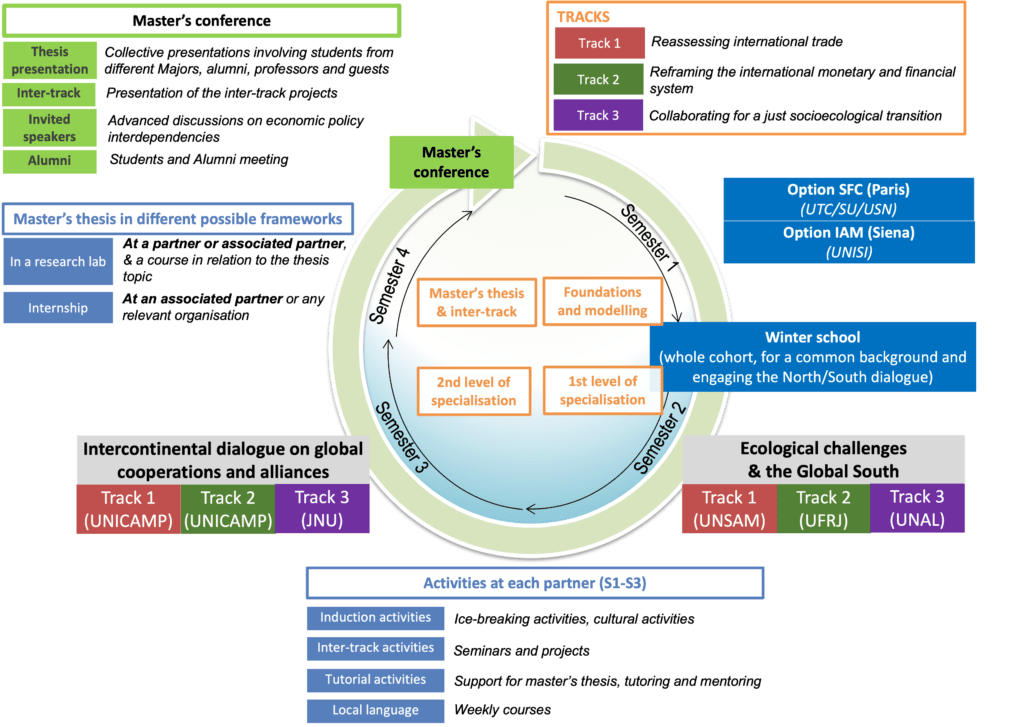
    The choice of track and option defines the focus of knowl­edge and skills devel­op­ment, as well as the cor­re­spond­ing stu­den­t’s mobil­i­ty:

    • the Semes­ter 1 in Europe, at Paris (option SFC) or Siena (option IAM), the semes­ter end­ing with a joint “Win­ter school”,
    • the Semes­ter 2 in Latin Amer­i­ca, at Buenos Aires (Track 1), Rio de Janeiro (Track 2) or Medelin (Track 3),
    • the Semes­ter 3 at Camp­inas (Tracks 1 and 2) or Del­hi (Track 3).

    For the last semes­ter (Semes­ter 4), stu­dents have the oppor­tu­ni­ty to their Master’s the­sis in the most rel­e­vant con­text for their project, which can be a “research lab envi­ron­ment” or a “pro­fes­sion­al intern­ship”. The pro­gramme ends with a mas­ter’s con­fer­ence.


    The stu­dents can choose between two options for the Semes­ter 1, which are most­ly relat­ed to method­olog­i­cal content:

    The Semes­ter 1 focus­es on foun­da­tion­al cours­es in Macro­eco­nom­ics, Micro­eco­nom­ics, Econo­met­rics, and Devel­op­ment Eco­nom­ics, com­ple­ment­ed by spe­cialised cours­es (includ­ing modelling).

    In Paris, stu­dents ben­e­fit from a Latin Amer­i­can per­spec­tive through the renowned Insti­tute for Latin Amer­i­can Stud­ies (IHEAL) and a method­olog­i­cal empha­sis on SFC modelling. 

    The Semes­ter 1 focus­es on foun­da­tion­al cours­es in Macro­eco­nom­ics, Micro­eco­nom­ics, Econo­met­rics, and Devel­op­ment Eco­nom­ics, com­ple­ment­ed by spe­cialised cours­es (includ­ing modelling).

    In Siena, the cur­ricu­lum inte­grates a Glob­al South per­spec­tive and offers a focus on “Inte­grat­ed Assess­ment Mod­els”, pro­vid­ing stu­dents with a com­pre­hen­sive under­stand­ing of devel­op­ment and eco­log­i­cal challenges.

    The, the Semes­ters 2 and 3, the course is then struc­tured around three Tracks, cov­er­ing three main areas of eco­nom­ic poli­cies:

    Stu­dents in Track 1 (Reassess­ing inter­na­tion­al trade) focus on inter­na­tion­al trade and its recent trans­for­ma­tions result­ing from the upheaval of the geopo­lit­i­cal order, as well as on its cen­tral role in secur­ing access to raw mate­ri­als and glob­al val­ue chains. It exam­ines eco­log­i­cal issues posed by trade and dis­cuss­es how trade can be rethought to fos­ter new forms of coop­er­a­tions and alliances, in par­tic­u­lar between the EU and the Glob­al South. 

    Stu­dents spend the Semes­ter 2 at UNSAM (Buenos Aires, Argenti­na) and Semes­ter 3 at UNICAMP (Camp­inas, Brazil). 

    Dur­ing S2, stu­dents pri­mar­i­ly exam­ine trade, indus­tri­al pol­i­cy and sus­tain­able devel­op­ment, with a par­tic­u­lar focus on the ener­gy tran­si­tion and the inter­na­tion­al gov­er­nance of eco­log­i­cal issues. They also address the dig­i­tal tran­si­tion and ques­tions relat­ed to sov­er­eign development. 

    Dur­ing S3, stu­dents study inter­na­tion­al trade from a glob­al per­spec­tive, notably through the analy­sis of glob­al val­ue chains, as well as indus­try and tech­nol­o­gy in China. 

    Stu­dents par­tic­i­pate to the “Inter-track” joint sem­i­nars and projects dur­ing S2 and S3.

    Stu­dents in Track 2 (Refram­ing the inter­na­tion­al mon­e­tary and finan­cial sys­tem) focus on the inter­na­tion­al mon­e­tary and finan­cial sys­tem and the way it can sup­port eco­nom­ic sta­bil­i­ty, fair trade, appro­pri­ate invest­ment con­di­tions, a reli­able pay­ments infra­struc­ture, and the capac­i­ty to engage effec­tive­ly with the eco­log­i­cal tran­si­tion. Recent devel­op­ments – includ­ing the rise of cryp­tocur­ren­cies, and sta­ble­coins in par­tic­u­lar – will be exten­sive­ly addressed. 

    Stu­dents spend the Semes­ter 2 at UFRJ (Rio de Janeiro, Brazil) and Semes­ter 3 at UNICAMP (Camp­inas, Brazil). 

    Dur­ing S2, stu­dents work on mon­e­tary pow­er in the glob­al econ­o­my and on the com­plex rela­tion­ships between finance, struc­tur­al change, and sustainability. 

    Dur­ing S3, they study glob­al finance, its cur­rent trends and chal­lenges, and its impacts on the Glob­al South, with a view to fos­ter­ing new glob­al coop­er­a­tion and alliances. 

    Stu­dents par­tic­i­pate to the “Inter-track” joint sem­i­nars and projects dur­ing S2 and S3.

    Stu­dents in Track 3 (Col­lab­o­rat­ing for a just socioe­co­log­i­cal tran­si­tion) focus on the con­di­tions required for a just socioe­co­log­i­cal tran­si­tion that simul­ta­ne­ous­ly reduces inequal­i­ties with­in and between coun­tries, while ensur­ing an eco­log­i­cal tran­si­tion aligned with respect for plan­e­tary boundaries. 

    Stu­dents spend the Semes­ter 2 at UNAL (Medelin, Colom­bia) and Semes­ter 3 at JNU (Del­hi, India). 

    Dur­ing S2, stu­dents address the con­flicts asso­ci­at­ed with the eco­log­i­cal cri­sis and exam­ine dif­fer­ent pos­si­ble devel­op­ment path­ways. They are intro­duced to labour eco­nom­ics from a dual per­spec­tive that cov­ers both the Glob­al North and the Glob­al South. 

    Dur­ing S3, stu­dents deep­en their analy­sis of labour and its rela­tion­ship with a just socio-eco­log­i­cal tran­si­tion, as well as of labour and glob­al val­ue chains, from a Glob­al South per­spec­tive. A par­tic­u­lar empha­sis is placed on inequal­i­ties and infor­mal­i­ty, in a con­text where infor­mal labour rep­re­sents around 90% of the work­force in many coun­tries of the Glob­al South. Stu­dents are also encour­aged to choose an elec­tive course to broad­en their under­stand­ing of region­al per­spec­tives on the Indi­an econ­o­my and soci­ety, and more broad­ly on Asian economies and societies. 

    Stu­dents par­tic­i­pate to the “Inter-track” joint sem­i­nars and projects dur­ing S2 and S3.

    The core design of the GLOBAL COOP Master’s pro­gramme empha­sis­es the devel­op­ment of spe­cialised exper­tise (aligned with the select­ed track), while fos­ter­ing exchanges, dia­logue, and col­lab­o­ra­tion among stu­dents across dif­fer­ent tracks. This approach aims to cul­ti­vate a shared under­stand­ing of eco­nom­ic poli­cies for sus­tain­able pros­per­i­ty and their intri­cate interdependencies.

    Semes­ters 1Foun­da­tion­al knowl­edge includ­ing includ­ing core ana­lyt­i­cal and mod­el­ling tools (end­ing with a joint Win­ter school);
    Semes­ters 2 and 3Advanced cours­es in the spe­cial­i­sa­tion field (Track).

    Semes­ter 2 (S2) offers key cours­es address­ing eco­log­i­cal chal­lenges, in close con­nec­tion with the select­ed track.

    Semes­ter 3 (S3) pro­vides a ded­i­cat­ed space for a sci­en­tif­ic inter­con­ti­nen­tal dia­logue on glob­al coop­er­a­tion and alliances, ensur­ing that stu­dents engage aca­d­e­m­i­cal­ly and pro­fes­sion­al­ly with at least three con­ti­nents.

    Pro­vi­sion of a com­mon cul­ture to the whole cohort.
    An har­monised inter-track struc­ture in S2/S3 devel­ops a deep­er under­stand­ing of the inter­link­ages between eco­nom­ic pol­i­cy domains while devel­op­ing in-depth per­spec­tives on oth­er regions of the Glob­al South, par­tic­u­lar­ly Africa and Asia.
    The ‘inter-track’ joint sem­i­nars fos­ter inter­dis­ci­pli­nary dia­logue and col­lab­o­ra­tion among stu­dents from dif­fer­ent tracks, pro­mot­ing a com­pre­hen­sive under­stand­ing of sus­tain­able pros­per­i­ty chal­lenges.
    The ‘inter-track’ joint projects, ini­ti­at­ed in S2/S3 and com­plet­ed dur­ing S4 encour­age col­lab­o­ra­tive work across tracks and cul­mi­nate in inno­v­a­tive con­tri­bu­tions that will be pre­sent­ed at the Master’s conference.
    Semes­ter 4Enhance­ment and appli­ca­tion of pre­vi­ous learn­ing out­comes.

    Stu­dents choose between (i) writ­ing the Master’s the­sis in the con­text of a “pro­fes­sion­al intern­ship” or (ii) writ­ing the Master’s the­sis in a “research lab envi­ron­ment”.

    Depend­ing on their Master’s the­sis project and career per­spec­tives, stu­dents will stay at one of the insti­tu­tions on their path­way, vis­it one of the part­ners or asso­ci­at­ed part­ner, or go at any oth­er rel­e­vant institution. 

    Down­load the GLOBAL COOP leaflet.

    GLOBAL COOP Newsletters : subscribe !